
EGLIN AIR FORCE BASE, Fla. -- The Air Force Research Laboratory (AFRL) recently verified that Anduril’s Barracuda-M family of cruise missiles meets the Air Force’s Weapon Open Systems Architecture (WOSA) standard, a framework intended to help weapons remain adaptable as technology, threats and mission needs change. The verification followed a four-day independent assessment of 14 weapon-system domains.
“Our North Star for acquisition transformation is an unrelenting focus on mission outcomes: delivering decisive capability to the warfighter,” said Brig. Gen. Douglas Wickert, Department of the Air Force (DAF) Technology Executive Officer and AFRL commander. “WOSA advances operational readiness by giving programs a verified path to turn new technology into adaptable warfighting capability. By validating that open systems work at scale, we are fundamentally changing how we transition technology and enabling the rapid integration and fielding of new innovations faster than the threat evolves.”
In partnership with industry, WOSA establishes common interfaces that allow weapon subsystems — including seekers, navigation modules, software, payloads and more — to be developed, integrated and upgraded independently. Instead of redesigning an entire weapon around a new component, WOSA enables programs to integrate new technology through defined interfaces as mission requirements, threats and technology evolve.
The milestone comes less than a year after the Secretary of War called on industry and the Department of War to make modularity a priority for weapons development. At the 2026 Modular Open Systems Approach Industry and Government Summit, department acquisition officials emphasized that open architecture depends on standard interfaces being implemented, tested, reused and applied across programs. WOSA provides a DAF mechanism for applying that principle to weapons systems through defined interface requirements and independent verification. Secretary of the Air Force Troy Meink has also described open systems architecture as a means to accelerate procurement and increase competition.
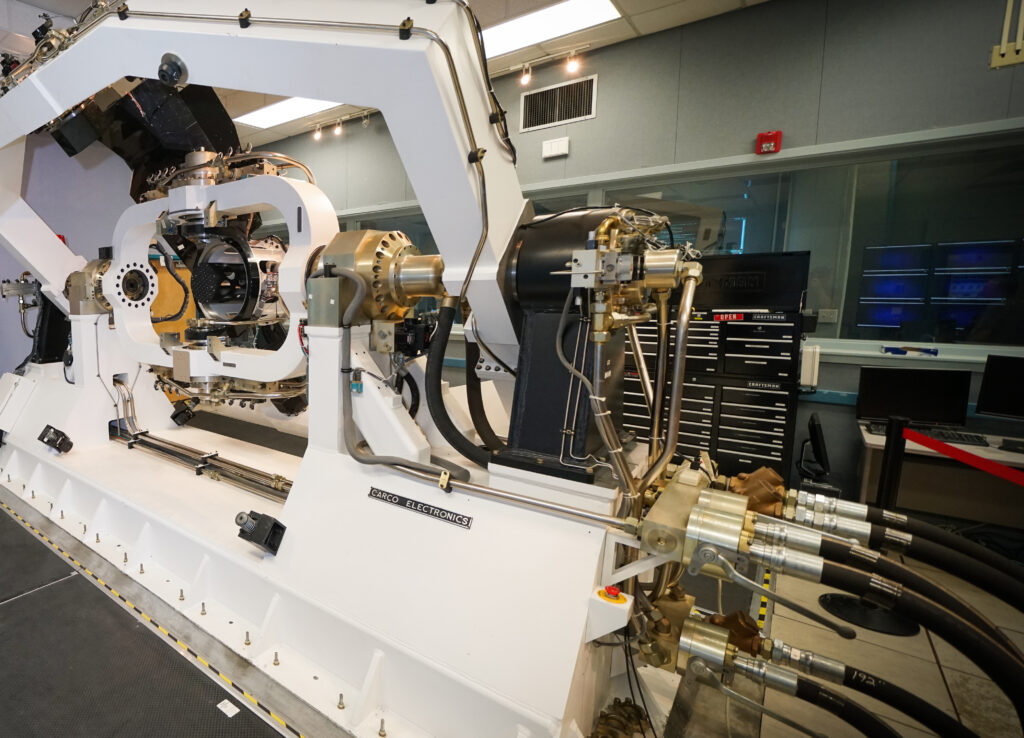
Located within AFRL’s Air Warfare Directorate, the Munition Open Architecture Test and Evaluation Laboratory (MOATEL) provides independent testing against WOSA requirements and gives government program offices and industry a common means of determining whether a weapon conforms to the WOSA standard.
“Open architecture is only meaningful when it can be independently verified, and for WOSA that verification occurs at MOATEL,” said Jonathan Shaver, AFRL project manager and creator of WOSA. “AFRL owns that check instead of accepting vendor self-assessment. WOSA verification at MOATEL lets us prove new science in the lab and make it ready for a weapon, showing open architecture can scale beyond prototypes. Without that independent S&T-to-MOATEL path, the industrial base cannot deliver new technology at the speed the fight requires.”
In partnership with AFRL, Anduril completed the four-day verification at MOATEL assessing 14 WOSA domains: Mission Autonomy, Seeker, Inertial Measurement Unit, Global Positioning System, Air-Data Sensor, Propulsion, Airframe Control, Target State Estimator, Altimeter Aiding Navigation, Clock, Autopilot, Guidance, Navigation and Munitions Data Bus (MDB). The test demonstrated modularity between Anduril’s internal and external MDB implementations, enabling rapid technology refresh of WOSA-compliant software. It also verified that Anduril’s software architecture met the WOSA requirements for the domains under test.
Modular, configurable architectures can support reuse across multiple weapon platforms when they meet applicable interface and integration requirements. That combination of independent verification, reduced integration risk and reuse gives current and future weapons programs a faster path from new technology to the warfighter.
Barracuda-M’s assessment represents a production-scale example of the verification process AFRL will continue to apply as additional weapons programs move through development and production. Through MOATEL, AFRL provides an independent path for programs to assess open-architecture conformance and integrate new technology as requirements, threats and missions evolve.
About AFRL
The Air Force Research Laboratory is the Department of the Air Force’s primary scientific research and development center and one of six centers within Air Force Materiel Command. AFRL leads the discovery, development and delivery of technologies for air, space and multidomain. With a workforce spanning seven mission areas at more than 40 locations worldwide, AFRL conducts research ranging from basic science to advanced technology development. For more information, visit afresearchlab.com.